Workout Plans
The Beginner Full-Body Dumbbell Workout (3 Days a Week)
October 3, 2026 · 5 min read · Training
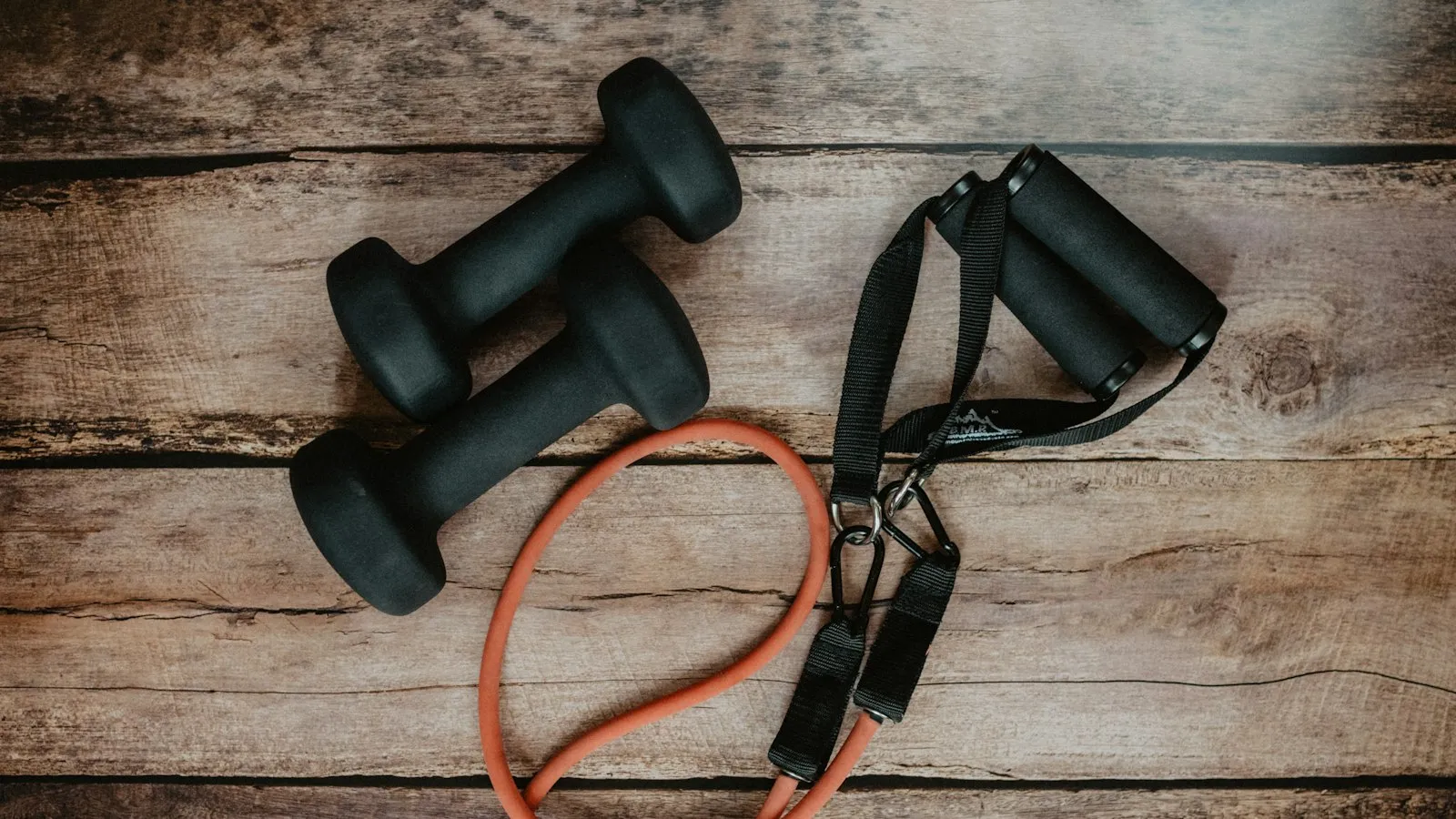
If you have a pair of dumbbells and 40 minutes three times a week, you have everything you need to get meaningfully stronger. This routine trains your whole body every session, which lines up with research showing that hitting each muscle at least twice a week builds more muscle than once a week (Schoenfeld et al., 2016) — and it covers the WHO’s recommendation of muscle-strengthening on two or more days a week (Bull et al., 2020).
Calculated from Workouts A and B below, alternating three times a week (1.5 of each per week). Main muscle = 1 set, major helper = ½ set. A good beginner range; add sets gradually as you progress.
View as table
| Item | sets |
|---|---|
| Glutes | 11.3 |
| Quads | 9 |
| Back | 9 |
| Hamstrings | 6.8 |
| Chest | 4.5 |
| Shoulders | 6.8 |
| Core | 6 |
What you need
- One pair of adjustable dumbbells, or two to three fixed pairs (light, medium, heavy)
- A sturdy chair, bench or step
- About 2 × 2 metres of floor space
The schedule
Train three non-consecutive days, for example Monday, Wednesday, Friday. Alternate between Workout A and Workout B:
| Week | Mon | Wed | Fri |
|---|---|---|---|
| 1 | A | B | A |
| 2 | B | A | B |
Workout A
| Exercise | Sets × reps | Rest |
|---|---|---|
| Goblet squat | 3 × 8–12 | 90 s |
| Dumbbell bench or floor press | 3 × 8–12 | 90 s |
| One-arm dumbbell row | 3 × 10–12 each | 60 s |
| Dumbbell Romanian deadlift | 3 × 10–12 | 90 s |
| Dead bug | 2 × 8 each side | 45 s |
Workout B
| Exercise | Sets × reps | Rest |
|---|---|---|
| Reverse lunge | 3 × 8–10 each leg | 90 s |
| Seated dumbbell shoulder press | 3 × 8–12 | 90 s |
| Chest-supported or bent-over row | 3 × 10–12 | 60 s |
| Hip bridge (dumbbell on hips) | 3 × 12–15 | 60 s |
| Dead bug | 2 × 8 each side | 45 s |
Chest gets the least direct work; if you want more, add 2 sets of push-ups to Workout B.
Choosing your weights
Pick a weight for each exercise that lets you complete the bottom of the rep range with good form and about 2–3 reps left in the tank. If you can’t hit the bottom of the range, go lighter. If you blow past the top, go heavier. Expect to adjust during the first two weeks — that’s normal.
How to progress (double progression)
- Start each exercise at the bottom of the rep range (e.g., 8 reps).
- Add a rep or two each session while keeping form clean.
- When you hit the top of the range on all sets (e.g., 3 × 12), increase the weight and drop back to 8 reps.
With fixed dumbbells, if the jump to the next weight is too big, slow down each rep or add a fourth set before moving up.
Your first 12 weeks
| Weeks | Focus |
|---|---|
| 1–2 | Learn every movement. Leave 3 reps in reserve. |
| 3–6 | Double progression; aim to beat one number every session. |
| 7 | A lighter week: same weights, half the sets. |
| 8–12 | Keep progressing. Consider 4 sets on your favourite lifts. |
Warm up first
Spend 5 minutes on light cardio and mobility, then do one light set of the first exercise. See our guide to the 8-minute warm-up.
Common mistakes
- Rushing reps. Take 2–3 seconds to lower each weight.
- Going too heavy too soon. Form first; load second.
- Skipping the lower body. Legs are your biggest muscles — don’t neglect them.
- Not tracking. Write down every set so you know what to beat next time.
Exercise swaps
Not every exercise suits every body or every home. Swap within the same movement pattern and keep the sets and reps:
| Exercise | Easier option | Harder option |
|---|---|---|
| Goblet squat | Squat to a chair | Dumbbell front squat with a pause |
| Floor press | Incline push-up | Dumbbell bench press |
| One-arm row | Chest-supported row | Slower lowering, 3-second pause at the top |
| Romanian deadlift | Hip bridge | Single-leg Romanian deadlift |
| Reverse lunge | Static split squat | Bulgarian split squat |
| Shoulder press | Half-kneeling single-arm press | Standing press |
What a session looks like
| Time | What you do |
|---|---|
| 0–5 min | Warm-up: light cardio, leg swings, arm circles |
| 5–8 min | One light set of the first exercise |
| 8–38 min | Working sets, resting as written |
| 38–40 min | Dead bugs, then a minute of slow breathing |
Eat for the results
Training is the signal; food supplies the building blocks. Aim for a solid portion of protein at each meal, and plenty of vegetables. See how much protein you need.
How to know it’s working
- Your logged weights or reps go up most weeks.
- Stairs, carrying shopping and getting up from the floor feel easier.
- You recover between sessions without lingering soreness.
Keep walking on the days in between. Together with these three sessions, it’s an easy way to meet the WHO’s recommendation of at least 150 minutes of moderate activity each week plus muscle-strengthening on two or more days (Bull et al., 2020).
FAQ
Can I do this with only one pair of dumbbells? Yes. Use slower tempos and pauses on the exercises where the weight feels light, and single-arm or single-leg versions.
How long until I see results? Most people notice strength improvements within a few weeks. Visible changes take longer and depend on nutrition and consistency.
Should I add cardio? Walking on non-training days is ideal and helps you reach 150 minutes of weekly activity.
Is muscle soreness a sign it’s working? Not necessarily. Soreness is common in the first weeks and usually fades. Progress in your log is the better sign.
The bottom line
Three full-body sessions a week with one pair of dumbbells, progressed steadily, is a proven starting point. Run it for 8–12 weeks before changing anything.
Sources
- Schoenfeld BJ, Ogborn D, Krieger JW (2016). Effects of resistance training frequency on measures of muscle hypertrophy: a systematic review and meta-analysis. Sports Medicine. doi:10.1007/s40279-016-0543-8
- Bull FC et al. (2020). World Health Organization 2020 guidelines on physical activity and sedentary behaviour. British Journal of Sports Medicine. doi:10.1136/bjsports-2020-102955
This article is general education for healthy adults, not medical advice. Check with a qualified professional before starting a new exercise or nutrition plan, especially if you have a medical condition. Full disclaimer.
Keep reading

How Much Exercise Do You Actually Need? What the WHO Guidelines Say
The global minimums for cardio and strength training, translated into a week you can actually schedule — plus an 8-week starter plan.
The 20-Minute No-Equipment Workout You Can Do Anywhere
A full-body bodyweight circuit with beginner, intermediate and advanced options.
Progressive Overload: The One Principle Behind Every Program That Works
Why your body only changes when you ask it to do a little more — and five practical ways to do it.